Omnix Studio editorial guide | Research reviewed October 13, 2026 | All figures in USD unless noted. Illustrative budgets are not agency quotes.
A founder can spend $15,000 proving that a painful workflow deserves software, or spend six figures building features customers never asked for. The difference is not simply the developer’s hourly rate. It is how clearly the team defines the problem, how much infrastructure the first version needs, and what the product must do safely from day one.
If you need one planning number, consider roughly $15,000–$60,000 for a focused custom SaaS MVP as an initial working budget, not a surveyed universal price. A more complex product with integrations, detailed roles, or elevated security requirements can run well above $100,000. The final cost could be lower or higher depending on scope, region, delivery model, and how much you build yourself. We derive the working range from explicit effort assumptions and compare it with published software-project and specialist-agency data below.
The goal of this guide is to give you a usable answer: what you are buying, what it might cost, what not to build, and how to decide whether a proposal is credible. There is also a free editable budget estimator and a feature-prioritization worksheet in the supporting resources.
Key takeaways
- MVP means the smallest product that can test a real customer problem, not a cut-down version of every feature on your future roadmap.
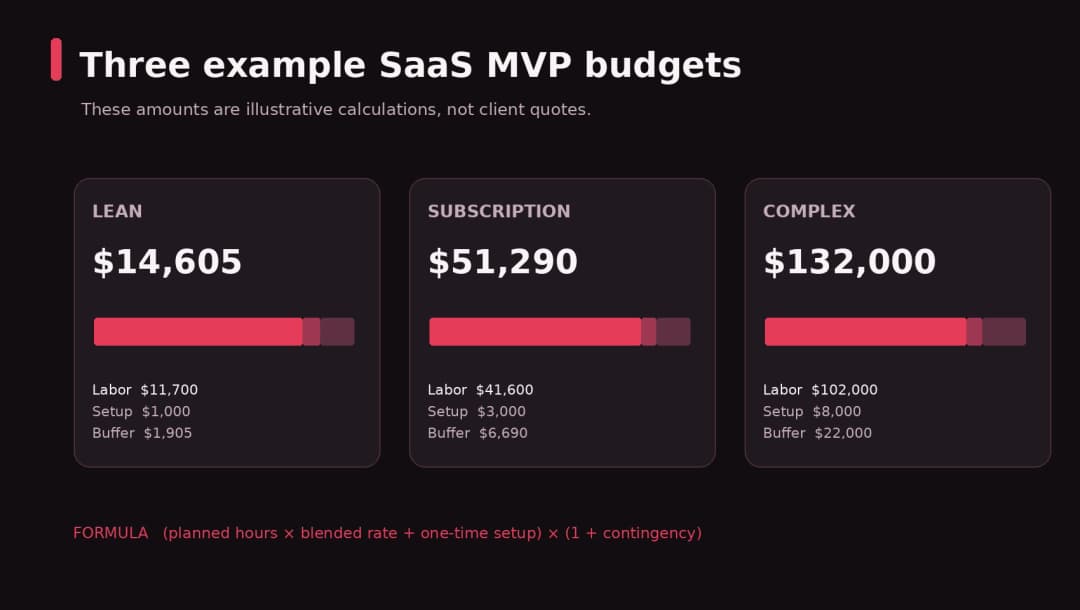
- Our illustrative planning examples total $14,605 for a lean workflow SaaS, $51,290 for a subscription SaaS, and $132,000 for a complex multi-role product. They are transparent mathematical models, not reported project invoices.
- Clutch’s September 2026 software-development guide says the most common reviewed project band is $10,000–$49,999, the average project is about $132,480, and common listed agency rates are $25–$49/hour. Its sample covers all kinds of custom software, not SaaS MVPs alone. [1]
- A specialist provider’s published estimate puts agency-built SaaS MVPs at $60,000–$150,000 for a 3–4 month project. That is a provider estimate rather than independent market-wide data. [2]
- Plan for product discovery, UX, engineering, integrations, quality assurance, release work, and postlaunch support. The cheapest initial build is not necessarily the cheapest product to maintain.
- AI-assisted coding may speed up implementation, but it does not erase authorization, privacy, data recovery, or product-validation work.
What counts as a SaaS MVP?
A SaaS MVP is the smallest hosted software product that lets a defined customer complete one meaningful task and lets the team learn whether the solution is valuable. It often includes login, the central workflow, basic account administration, analytics, and a dependable path for feedback. It may require billing if willingness to pay is the hypothesis being tested, but subscriptions are not mandatory on day one.
Imagine Northstar Approvals, a fictional product for small agencies that repeatedly chase sign-offs for marketing assets. The core promise is simple: send an approval request, capture one decision, and retain a history everyone can find. A useful first release needs team membership, a request form, an approval link or authenticated reviewer view, status changes, and notifications. It does not need AI summaries, a native mobile app, a public marketplace, twenty integrations, or elaborate analytics dashboards to test that promise.
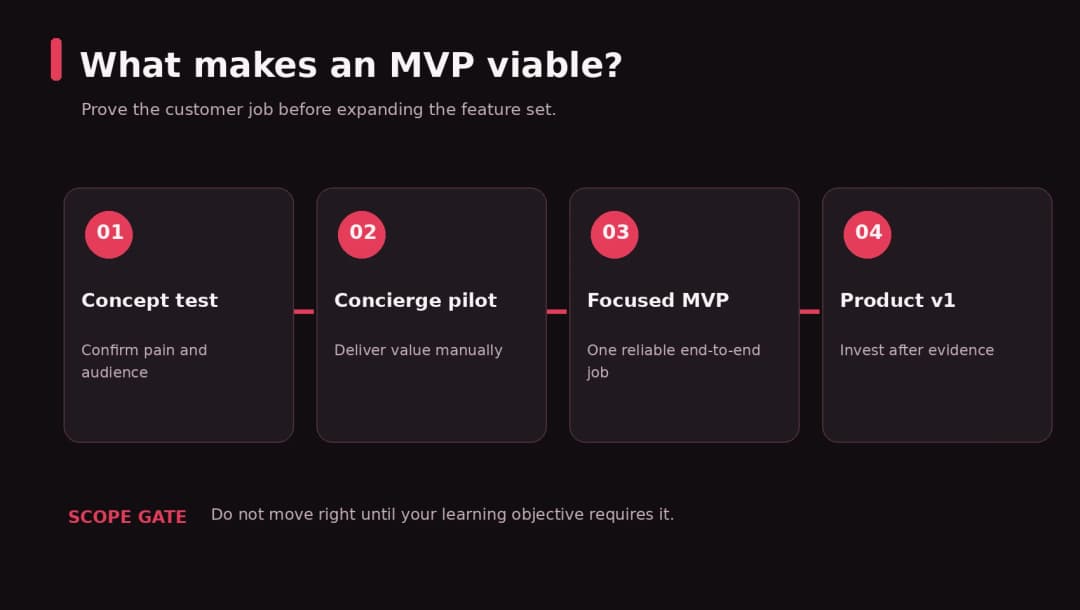
This distinction matters financially. A landing-page test might tell you whether people want the product, but it cannot prove the product works. Conversely, a polished multi-tenant app might work beautifully while answering no market question. The right stage depends on your evidence: concept validation, concierge/service-assisted pilot, working MVP, or scalable product v1. Y Combinator’s Startup School advocates getting the earliest usable product in front of customers and learning from them, rather than waiting for an oversized launch. [3]
SaaS MVP development cost in 2026: the useful ranges
A price list without scope is misleading. A single-user scheduling app, a billing portal with three roles, and a compliance-heavy system can all be marketed as an MVP. The cost difference lives in the requirements.
| MVP type | Illustrative planning range | Typical characteristics | Budget warning |
|---|---|---|---|
| Lean validation app | $10,000–$25,000 | One main workflow, managed services, limited roles | Founder does discovery and accepts narrow scope |
| Standard B2B SaaS MVP | $25,000–$75,000 | Accounts, subscriptions, workflow, admin, integrations | Billing, QA, and support may be underestimated |
| Complex or sensitive SaaS MVP | $75,000–$150,000+ | Multiple permissions, custom integrations, complex data | Governance and reliability can dominate effort |
These are Omnix Studio editorial planning bands, not a proprietary quote database or a price guarantee. Use the examples later in the article to calculate a budget for your own scope.
For a market reference, Clutch reports the most common software-development project at $10,000–$49,999 but an average of $132,480, illustrating how widely the overall category varies. Clutch also lists regional company-rate differences; its US listing range is $50–$99/hour, while several lower-cost markets cluster at $25–$49/hour. These are agency listing patterns, not promises about the experience, availability, or quality of a particular team. [1]
A specialist studio, Nextcraft, publishes an MVP agency estimate of $60,000–$150,000 for roughly three to four months, while estimating a fuller product v1 at $150,000–$400,000. Treat this as one firm’s scope and delivery perspective, useful for triangulation but not an independent census. [2]
What exactly are you paying for?
A good SaaS quote separates four kinds of work. Product definition establishes the target user and acceptance criteria. Design makes tasks understandable and reduces ambiguous engineering decisions. Implementation covers frontend, backend, data, integrations, authentication, and deployment. Assurance covers validation, testing, observability, backup, security review, and launch support.
If the quote includes only screen development, important pieces may be waiting as change requests. Ask whether testing, account isolation, webhooks, migrations, staging, accessibility, analytics, training, and source-code handoff are included.
Three example SaaS MVP budgets, calculated line by line
Rather than call arbitrary numbers “industry averages,” here are transparent fictional estimates. In each, base cost = planned hours × blended hourly rate + external setup expenses. Add contingency to cover reasonable unknowns. Tax, payment processing, ongoing vendor subscriptions, founder time, marketing, and postlaunch improvements are excluded unless stated.
Example A: Lean workflow MVP — $14,605
Northstar Approvals starts with one core workflow, email-based sign-off, two basic user roles, and a small admin screen. Assume 260 combined project hours at a $45 blended rate, $1,000 in setup expenses, and 15% contingency.
- Labor: 260 × $45 = $11,700
- One-time setup and tooling: $1,000
- Subtotal: $12,700
- Contingency: 15% × $12,700 = $1,905
- Illustrative total: $14,605
This works only if the scope stays tight. A proper permission check still belongs in the project. Sophisticated billing, white-label workspaces, dozens of notification combinations, and a separate mobile app do not.
Example B: Subscription SaaS — $51,290
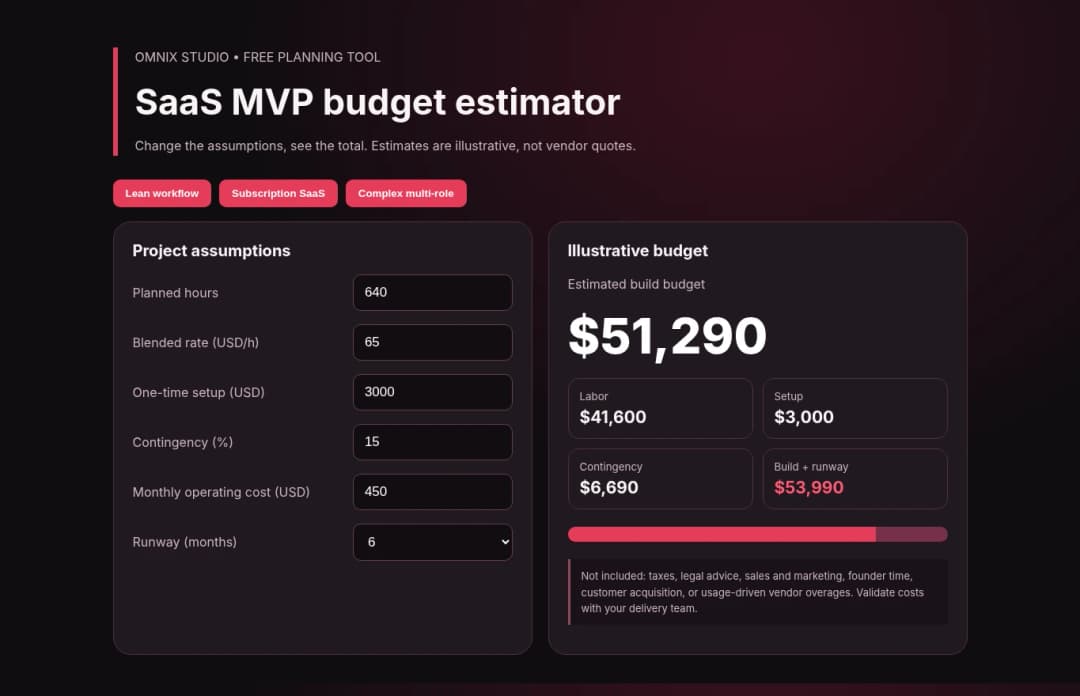
Suppose the product needs signup, multiple organizations, plan selection, paid subscriptions, role-based access, usage tracking, a customer dashboard, and a billing portal. Assume 640 combined hours at $65/hour, $3,000 in external setup expenses, and 15% contingency.
- Labor: 640 × $65 = $41,600
- One-time external expenses: $3,000
- Subtotal: $44,600
- Contingency: 15% × $44,600 = $6,690
- Illustrative total: $51,290
Billing introduces more than a checkout button: failed payments, webhooks, cancellations, refunds, subscription state, and customer support all need defined behavior. Stripe documents recurring pricing structures and related billing behavior, but processing and Billing charges vary by account, product, and country. [4]
Example C: Complex multi-role product — $132,000
Now assume multiple organization types, review queues, document permissions, third-party connections, audit logs, and higher resilience expectations. Using 1,200 hours at $85/hour, $8,000 in external expenses, and 20% contingency:
- Labor: 1,200 × $85 = $102,000
- One-time external expenses: $8,000
- Subtotal: $110,000
- Contingency: 20% × $110,000 = $22,000
- Illustrative total: $132,000
Do not read “complex MVP” as permission to skip security. If your product stores sensitive records, separates customer organizations, or supports financially meaningful actions, basic controls must be part of the initial scope. Industry checklists such as the OWASP Application Security Verification Standard help teams articulate and test expectations. [5]
The eight biggest factors that change a SaaS MVP quote
1. Number and depth of workflows
Count decisions, error cases, and approvals, not just screens. A “create invoice” page may need customer selection, tax rules, line-item editing, draft state, exports, retries, and permissions. Ten screens with complex logic can cost more than thirty straightforward content pages.
2. Authentication and organization boundaries
One admin and one user is simple relative to organizations with owners, billing administrators, members, guests, and external reviewers. Tenant isolation has to be enforced server-side. Hiding a tab in the interface is not an authorization system. Include invitations, password resets, account deletion, and role changes in acceptance tests.
3. Integrations and data synchronization
Every external API adds setup, sandbox environments, auth tokens, rate limits, incomplete data, retries, failures, and updates. A straightforward payment provider integration differs sharply from synchronizing contacts across three CRMs and an ERP. Prioritize integration value before counting connectors in a sales deck.
4. Data quality, migrations, and reporting
An MVP with fresh data may be simpler than one required to import thousands of historical records. Reporting also expands quickly: do users need activity logs, analytics, exports, filters, accounting reconciliation, or only a basic status view? Specify the question every report must answer.
5. Responsive design and accessibility
If early users work from their phones, mobile UX is a requirement, not a bonus. Contrast, focus indicators, understandable forms, and keyboard access should be part of implementation checks. Avoid creating separate desktop and mobile products unless native device functionality demands it.
6. Platform architecture and hosting model
A managed database/auth provider and a hosted frontend can reduce configuration work. A bespoke infrastructure stack can provide control but also requires someone to own deployments, backups, access policies, alerts, and patching. Compare total operational ownership, not brand popularity.
7. Reliability, security, and regulated data
A pet-project prototype may tolerate manual admin correction; a payment or healthcare workflow may not. Auditability, data retention, encryption, incident response, and formal compliance obligations must be defined by risk and jurisdiction. Never assume “MVP” exempts your team from legal or security requirements.
8. Feedback speed and decision ownership
An agency waiting a week for every approval burns time, even when its coding rate is low. A founder who names one decision owner, prepares realistic content, and signs off on clear acceptance criteria can reduce rework. Delivery model often matters as much as geography.
Build it yourself, hire freelancers, or hire an agency?
There is no universally cheapest method after accounting for risk and founder attention.
| Delivery model | Where it can work | What you must own | Key risk |
|---|---|---|---|
| Founder / small internal team | Technical founder with time and ability | Product, design review, security, operations | Opportunity cost and untested assumptions |
| Freelance specialists | Narrow, documented scope with technical oversight | Project management, integration, QA, handoff | Gaps between independent contributors |
| Product agency | End-to-end defined delivery and stakeholder alignment | Scope decisions, feedback, product direction | Higher visible price and unclear change policy |
| AI-assisted engineering | Fast iteration with competent reviewers | Tests, permissions, code review, deployment | Generated code can look complete while failing edge cases |
A rate of $30/hour does not automatically beat $75/hour. Compare total hours × rate, delivery quality, change-control terms, handoff, and what happens if key staff leave. Ask vendors to explain how they budget QA and fixes without hiding them in optimistic estimates.
How much does hosting a SaaS MVP cost each month?
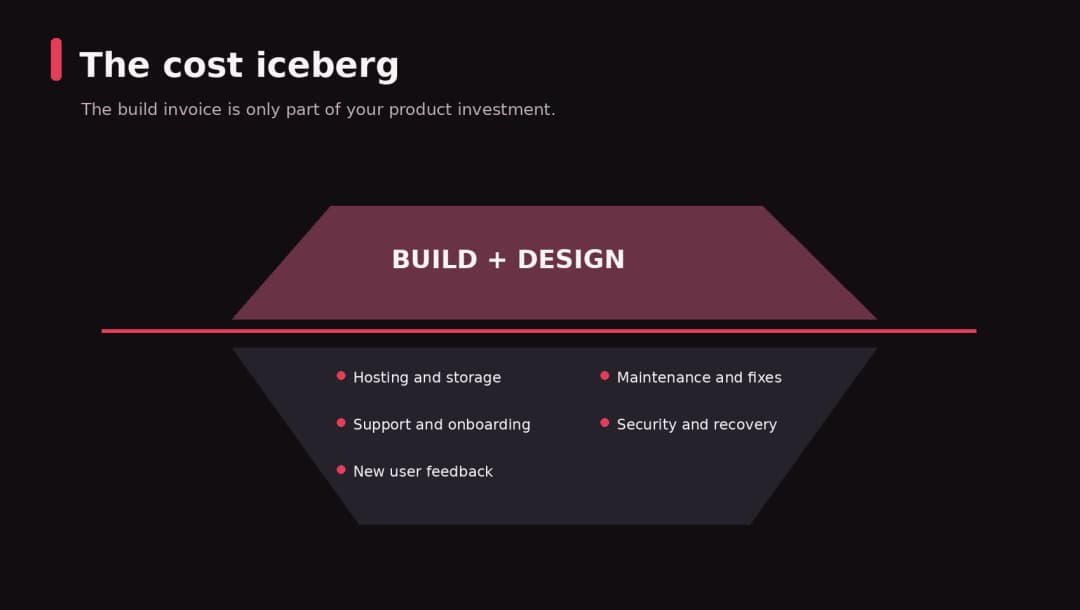
Your development invoice is only one part of the cost. At launch, common ongoing categories include application hosting, database/storage, transactional email, observability, backups, payment processing, customer support, and ongoing maintenance.
For two transparent plan examples in October 2026, Vercel currently lists a Pro platform starting at $20/month with included usage credit, while Supabase lists Pro starting at $25/month, with allowances and potential overages. Those prices do not cover your complete product: production usage, additional seats/projects, email, support tools, payment processing, and infrastructure can increase the total. [6][7]
The AWS Pricing Calculator is useful when you choose cloud infrastructure directly, but its estimates depend on region, architecture, and usage assumptions. Do not copy a generic “$50/month” figure into an investment deck unless it is backed by a realistic workload. [8]
A practical operating budget has two scenarios: quiet-launch (first 100 users and low traffic) and growth-pressure (ten times the users, more files, background jobs, and support needs). Separate vendor fees from engineer time. If you have no user-volume assumptions, use a sensitivity model rather than pretending the monthly bill is fixed.
An MVP feature list that protects your budget
Here is how we would scope fictional Northstar Approvals before asking for quotes.
| Priority | Feature | Why it belongs (or waits) | Release decision |
|---|---|---|---|
| Must | Organization owner and reviewer roles | Teams need safe access boundaries | MVP |
| Must | Submit an item for approval | Central problem being tested | MVP |
| Must | Approve / request changes | Required completion state | MVP |
| Must | Email notification and activity history | Users need to know the result | MVP |
| Must | Simple mobile-accessible interface | Reviewer may be on a phone | MVP |
| Should | Basic search and saved filters | Improves use as records grow | After first pilot |
| Later | Native mobile app | Adds separate platform cost | Only after mobile demand |
| Later | AI-generated summaries and insights | Does not prove initial value | Only after repeated need |
| Later | Twenty CRM and storage integrations | Adds test and maintenance surface | Prioritize by pilot evidence |
The most important tool is a non-goals list. “Not included in MVP” should appear in the proposal with the same clarity as “included.” A team that cannot say no to work will struggle to keep any MVP budget.
Five acceptance criteria worth writing down
- A customer can create a workspace and invite a reviewer without developer assistance.
- Reviewers can access only records they are authorized to view, verified on the server and with negative tests.
- A submitted request can reach a final state, and that state persists after refresh or login.
- Failed email delivery, invalid uploads, and double submissions produce a safe, understandable result.
- A second developer can check out the repository, run tests, and deploy using written instructions.
These are examples, not a substitute for your own product specification. They demonstrate why a page count is not enough for estimating software.
How to estimate your own MVP, step by step
Step 1: Write the customer job in one sentence. Use a verb and a result: “Operations managers can approve vendor requests in one place.” If the sentence contains six unrelated promises, the scope is too broad.
Step 2: Map one end-to-end journey. Start at invitation/signup. End at the moment the user obtains the promised value. Mark permissions, notifications, and likely failure states.
Step 3: Split the work into deliverables. Product discovery; wireframes; visual design; frontend; backend and database; integrations; QA and accessibility; deployment and documentation. Avoid assigning all work to “developer.”
Step 4: Put hours beside each deliverable. Ask your implementer to show estimates and their assumptions. A wide range is more credible than false precision.
Step 5: Use a realistic blended rate. Rate cards vary by seniority, location, and engagement. Use your actual shortlisted team’s quote, not Clutch’s overall average as if it were universal.
Step 6: Add one-time third-party setup expenses and contingency. For early planning, a 10–20% contingency can be a useful scenario assumption, but it is not a universal rule. Clarify whether contingency is controlled by the client, agency, or both.
Step 7: Estimate operating runway. Model 3, 6, and 12 months of hosting and maintenance separately from your development total. Decide what you can afford if revenue arrives late.
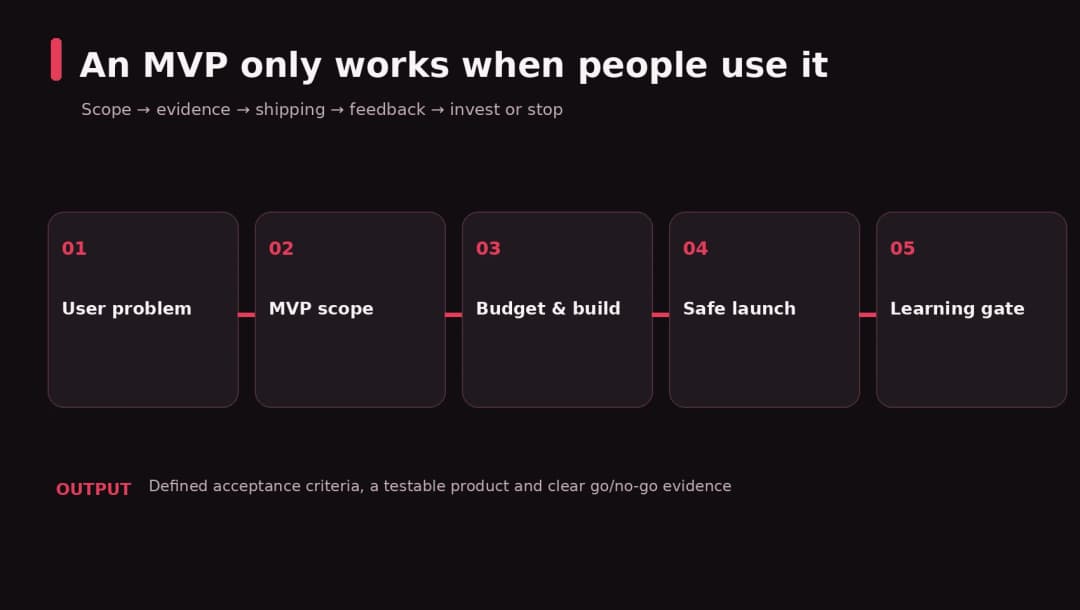
Step 8: Define a stop/go test. Specify a small number of users, completed tasks, and willingness-to-pay signals that justify a next investment. For example: “Five pilot companies complete at least three approval requests per week and two agree to pay for continued use.” That is a proposed learning gate, not a success benchmark.
An estimate formula you can audit
Build subtotal = planned hours × blended hourly rate + one-time external expenses.
Estimated build budget = build subtotal × (1 + contingency percentage).
Cash needed through first X months = estimated build budget + (monthly operations × X) + separate sales/legal/marketing reserves.
The attached budget estimator implements the first two formulas and the operating runway addition. It deliberately does not pretend to predict your revenue, product-market fit, legal costs, or actual hosting bill.
Common ways founders overspend on their first SaaS product
Building for an imaginary enterprise customer. SSO, granular permissions, and export approvals may be essential for a target buyer, or may be speculative features for a product that has no buyers yet. Ask which customer requires each feature and why.
Treating AI output as a test plan. An AI agent can generate a convincing dashboard, but a green preview cannot demonstrate safe organization boundaries, billing state, backup recovery, or accessibility. Keep code review and adversarial checks.
Skipping UX because an engineer can build screens. The least expensive screen is the one you do not have to rebuild after the first user test. Wireframes and task flow reviews are cheaper than reworking deeply embedded business logic.
Choosing every integration in advance. Connect only what a committed pilot requires. Unsupported APIs, token refresh flows, data conflicts, and vendor changes create ongoing cost.
Signing an undefined fixed-price contract. Fixed price works when scope, acceptance criteria, exclusions, milestone ownership, and change requests are explicit. “Build an AI-powered SaaS platform” is not a scope of work.
Forgetting the second month. A product is not shipped and finished. Bugs, failed payments, onboarding friction, analytics errors, and customer questions appear after launch. Allocate an operating budget and define who responds.
Questions to ask before accepting a SaaS MVP quote
Ask the potential team to show the breakdown in writing. What is the smallest learning goal? What is explicitly excluded? Who owns the repository and accounts? Which data is stored and where? How are roles enforced? What does QA include? What counts as acceptance? Who handles deployment, backup, incident response, billing problems, and postlaunch fixes? Can another team maintain the product without a rewrite?
Compare two quotes against the same acceptance criteria and exclusions. If one excludes QA or third-party costs, it is not directly comparable to a full-delivery quote. Use the attached quote-comparison worksheet to record these differences.
When an agency is worth involving
A technical founder with a limited workflow may be able to build and validate cheaply. An agency becomes more useful when design quality, multiple disciplines, delivery accountability, integrations, or handoff risk would otherwise consume the founder’s attention.
At Omnix Studio, design and development work can support product discovery, SaaS UX, prototypes, custom web applications, and launch preparation. A useful first conversation is not “How much for my app?” but “What is the cheapest credible experiment that validates the customer’s job?” Request a scoped plan before committing to the full roadmap.
This article complements our existing Omnix Studio blog coverage of design, prototyping and custom website development. Once related October posts are actually published, connect this guide contextually to the SaaS UX audit and WordPress/Next.js decisions, without guessing their future URLs.
Frequently asked questions
Can you build a SaaS MVP for $5,000?
Sometimes, if a technical founder does most of the work, the product is extremely narrow, or the first test uses a no-code/concierge approach. That is not a sensible universal price for a custom multi-tenant paid SaaS. Define what “built” means: a demo, a limited pilot, or a maintained production service.
Is $50,000 enough for a SaaS MVP?
It may be enough for a focused web MVP with deliberate scope, managed infrastructure, and a suitable delivery team. Our $51,290 example shows one plausible composition, but your actual requirements and rates determine whether that budget holds.
How long does a SaaS MVP take to develop?
Scope and team capacity matter more than a universal timeframe. A constrained workflow can be built in weeks with the right foundation; a complex multi-role platform may require months. Allow time for user interviews, design, testing, and feedback loops, not just writing code.
Is AI making SaaS development cheaper?
AI can accelerate repetitive tasks, scaffolding, and iteration when reviewed by skilled developers. It does not independently validate product demand, secure customer information, design thoughtful workflows, or guarantee maintainability. Do not discount testing based only on a tool demo.
Do I need subscription billing in version one?
Only if charging users is part of the validation goal or customer experience. A concierge pilot can sometimes test willingness to pay with manual invoices before you automate subscription lifecycle management. If the product launches with billing, test webhook retries, cancellations, refunds, access changes, and failed payments.
Can WordPress be used for a SaaS MVP?
For membership portals, content-led services, bookings, and workflows supported by suitable plugins, WordPress can reduce custom development. For complex multi-tenant application logic, a custom web stack may be a better fit. Judge based on permissions, domain logic, integrations, and maintenance rather than fashion.
What is the largest hidden cost after launch?
Often it is people-time: support, debugging, refactoring, incident response, and feature requests. Cloud fees matter, but assuming a low cloud bill means no maintenance cost can badly distort the runway plan.
Sources and editorial methodology
This guide combines verified vendor pricing and public agency-market data with transparent, fictional project models. It does not claim a survey of SaaS MVP invoices, a hands-on performance test, or customer results. Costs can change after this research date; verify product prices before contracting.
- Clutch: Software Development Company Pricing Guide, updated September 21, 2026.
- Nextcraft: How Much Does It Cost to Build a SaaS Product in 2026?, May 6, 2026.
- Y Combinator Startup School: How to Build an MVP.
- Stripe documentation: Recurring pricing models.
- OWASP: Application Security Verification Standard.
- Vercel pricing.
- Supabase pricing.
- AWS Pricing Calculator documentation.
Before publishing: Replace figure placeholders with uploaded WordPress media URLs, link only live Omnix pages, and recheck rates and vendor allowances.