
Omnix Studio editorial guide | Research reviewed October 14, 2026 | Audience: agency owners, account leads, operations managers, and delivery teams
Your agency wins a website project. The client loves your ideas. Then the proposal grows: a custom WordPress integration, a handful of landing pages, a membership portal, perhaps a demanding deadline. Your designers can handle the brand, but your developers are booked for another six weeks.
You could decline the work, hire in a rush, or try to stretch a small team. There is a fourth option: white label web development. An external development partner builds the site, while your agency manages the client relationship and delivers the work under its own brand.
The model sounds straightforward. The difficult part is everything that happens between signed proposal and a stable website. Who approves changes? Who owns the repository? Who speaks to the client? What happens when the launch breaks? This guide answers those questions with a practical operating model, a transparent pricing example, and checklists you can put to work.
Key takeaways
- White-label web development lets an agency sell and manage website projects while an external partner handles some or all of the technical delivery.
- White label is not the same as subcontracting by default. The agreement must say whether the partner is client-facing, credited, invisible, or allowed to reuse the work.
- A sustainable agency margin must cover discovery, project management, revisions, QA, warranty risk, and the partner invoice. Markup alone does not tell you your profit.
- The best pilot is small, representative, and measurable: a landing page, template conversion, or controlled integration with clear acceptance criteria.
- Written handoff rules for code, hosting, credentials, documentation, and post-launch support matter as much as price.
- For WordPress, least-privilege access, updated software, and explicit authorization checks are basic delivery requirements, not premium extras.
- Treat accessibility, performance, and SEO preservation as agreed acceptance criteria, not promises that everything will be ‘perfect.’
What is white label web development?
White label web development is an arrangement in which a development provider builds or maintains a website for an agency, and the agency sells and delivers that work under its own brand. The agency typically controls the customer relationship, project scope, billing, and final signoff. The provider supplies agreed technical expertise and production capacity.
Imagine a branding studio serving restaurants. It has a client who needs a fast multilingual WordPress site with online booking and a menu management workflow. The studio handles positioning, design, content approvals, and client communication. A specialist developer sets up the theme, templates, integrations, and testing environment. The restaurant signs with the studio, not with the specialist developer. The developer is paid by the studio according to their separate agreement.
That example describes the commercial arrangement, not a guarantee of confidentiality or anonymity. Some partners join agency calls under the agency’s brand. Others work entirely behind the scenes. Some are credited as technical collaborators. The contract and client expectations decide which model applies.
White label, outsourcing, freelancing, and staff augmentation: what’s different?
These terms overlap, but they answer different questions. Outsourcing is a broad decision to move work outside your organization. White label specifies how the work is branded and delivered. A freelancer describes the type of provider. Staff augmentation typically adds capacity under your team’s day-to-day direction. A referral sends the customer to another business, often ending your direct delivery role.
A developer can be a freelancer and still work white label. A dedicated offshore team can provide staff augmentation and also work behind an agency brand. Don’t choose a vendor based on terminology alone; ask how approvals, access, billing, and client communication actually work.
How the white-label agency model works
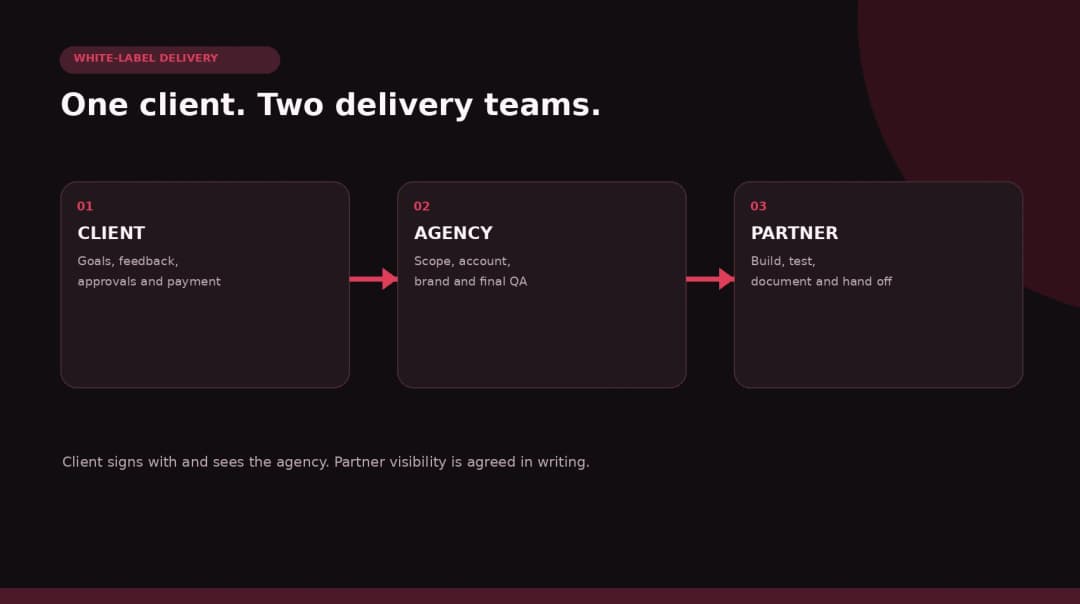
The healthiest version has three visible roles, even when only two companies appear to the end client.
The end client defines goals, approves outcomes, and pays the agency. The agency translates those goals into a scope, manages the relationship, ensures quality, and accepts delivery. The partner estimates and implements the agreed technical work, reports blockers, documents changes, and supports the agreed warranty period.
The usual delivery sequence is:
- Discovery and qualification. Your agency confirms the business problem, technology constraints, integrations, content ownership, and decision makers.
- Partner feasibility review. A technical lead checks requirements, dependencies, effort assumptions, unknowns, and proposed architecture before the client gets a fixed number.
- Dual scope agreement. Your client contract and partner statement of work should align, even though their prices and commercial terms differ.
- Private onboarding. The team receives an approved brief, project workspace, repo/staging access, brand materials, and an escalation route.
- Build and review. The partner ships milestones; the agency checks them against a shared acceptance list before showing the client.
- Client acceptance and launch. Agreed stakeholders approve, redirects and backups are verified, and the launch owner records the deployment.
- Handoff and support. Repositories, license records, credentials, admin training, and warranty terms are delivered and access is removed when appropriate.
Skipping partner feasibility review is tempting when the client says ‘it’s just five pages.’ Those five pages may depend on custom filtering, CRM sync, booking rules, and multilingual editorial workflows. A layout count is not a reliable effort estimate.
What work can you white label?
An agency can use a partner for one missing skill or for the entire development layer. Common options include:
- WordPress development: block themes, Gutenberg patterns, plugin integrations, custom post types, WooCommerce, migrations, performance work, and ongoing maintenance.
- Custom websites: React/Next.js interfaces, CMS integrations, server-side features, component libraries, and deployment pipelines.
- Commerce: WooCommerce or Shopify theme customization, product data handling, checkout configuration, payments, and order integrations.
- Landing pages: responsive builds from approved Figma files, campaign templates, forms, tracking, and testing support.
- Web apps: portals, dashboards, internal tools, membership workflows, and API-connected experiences.
- Maintenance: security updates, backups, monitoring, regression checks, and agreed support windows.
A generalist partner may be enough for a five-page marketing website. An authenticated customer portal with sensitive data needs stronger architecture, security review, and data-handling controls. Always match the partner’s demonstrated competency to the actual project risk.
Which work should stay inside your agency?
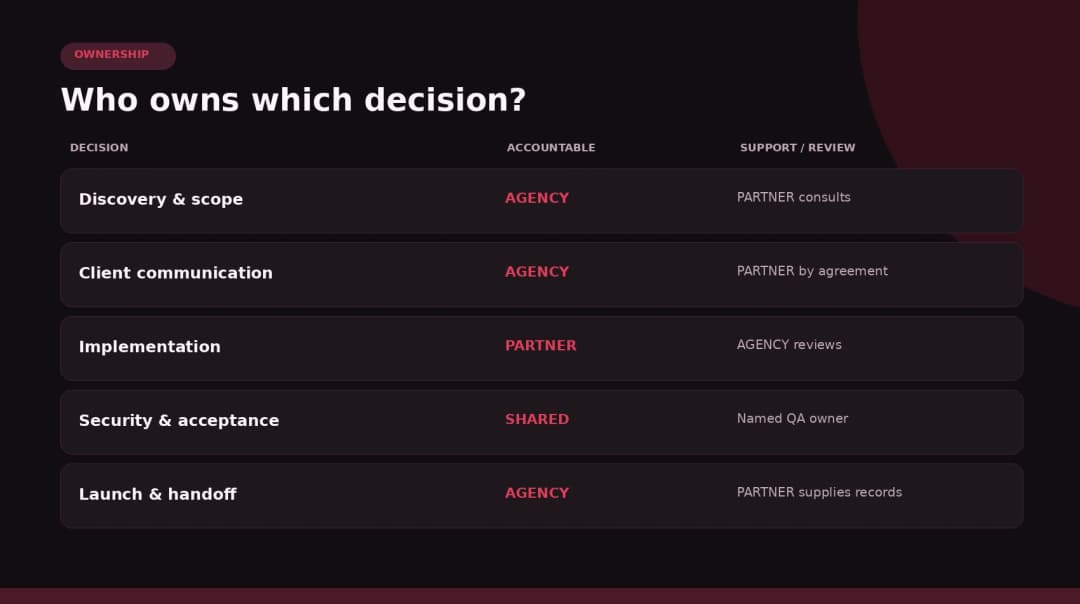
It depends on your positioning. Most agencies benefit from retaining client discovery, strategic recommendations, scope ownership, account communication, design direction, commercial decisions, and final QA acceptance. These responsibilities protect the relationship and keep your agency accountable for what it sells. You can delegate execution without delegating judgment.
The real benefits, and where the model can disappoint
The most obvious benefit is capacity. You can accept work that fits your positioning without waiting to recruit a permanent hire. You can also access narrow expertise for a defined period: a WordPress engineer for a migration, a frontend specialist for a complex animation, or a developer experienced in third-party APIs.
There is a financial benefit, too, but only if your agency can forecast partner hours and manage revisions. For a sporadic development workload, a variable project cost can be easier to carry than permanent payroll. On predictable volume, a retainer or embedded team can make scheduling easier. Neither structure automatically delivers better margins.
Other advantages include flexible delivery capacity, technical specialization, and the ability to combine design and engineering in one client offering. Yet there are real tradeoffs. Communication slows when feedback crosses too many layers. Scope changes can quietly erase margin. Inconsistent coding standards create long-term support costs. Poor handoff documentation makes the client dependent on a provider your agency cannot easily replace.
The strongest agencies do not sell the model as ‘unlimited development on demand.’ They build a repeatable quality system and maintain room for the unexpected.
What does white-label web development cost in 2026?
There is no trustworthy universal ‘white label rate.’ A brochure site, a custom WooCommerce integration, and a multi-tenant web application have different requirements. Location, seniority, project management coverage, warranty scope, and security expectations affect the quote.
For broad market context, Clutch’s September 21, 2026 web development pricing guide reports that most listed development agencies charge approximately $25–$49 per hour and that projects represented in its review data commonly cost less than $10,000. This is a snapshot of Clutch’s listed marketplace, not a validated market rate for a particular white-label partner, region, or scope. Source: Clutch.
Instead of choosing the cheapest advertised rate, ask for the estimate broken into discovery, build, QA, deployment, project management, and post-launch coverage. A $40/hour quote with no testing may cost more in practice than a higher quote with defined milestones and clean handoff.
A worked agency margin example
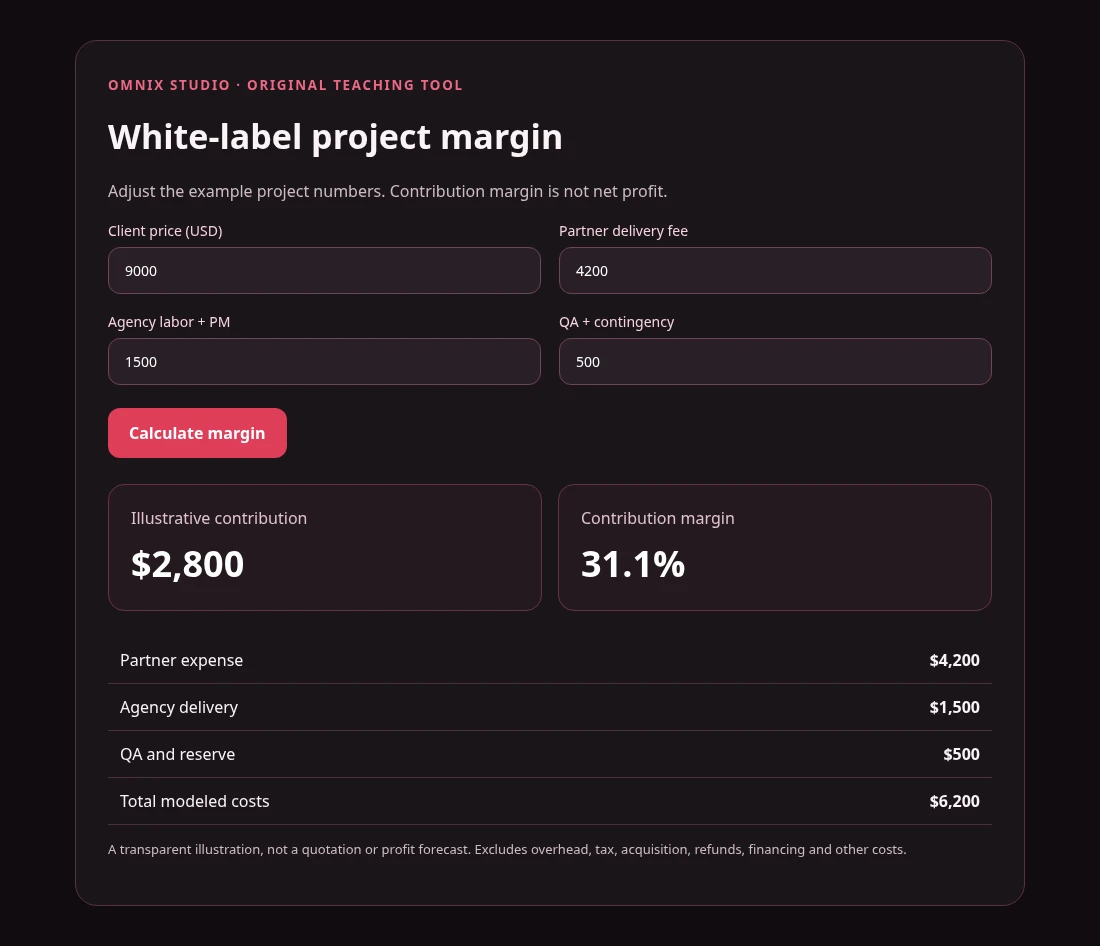
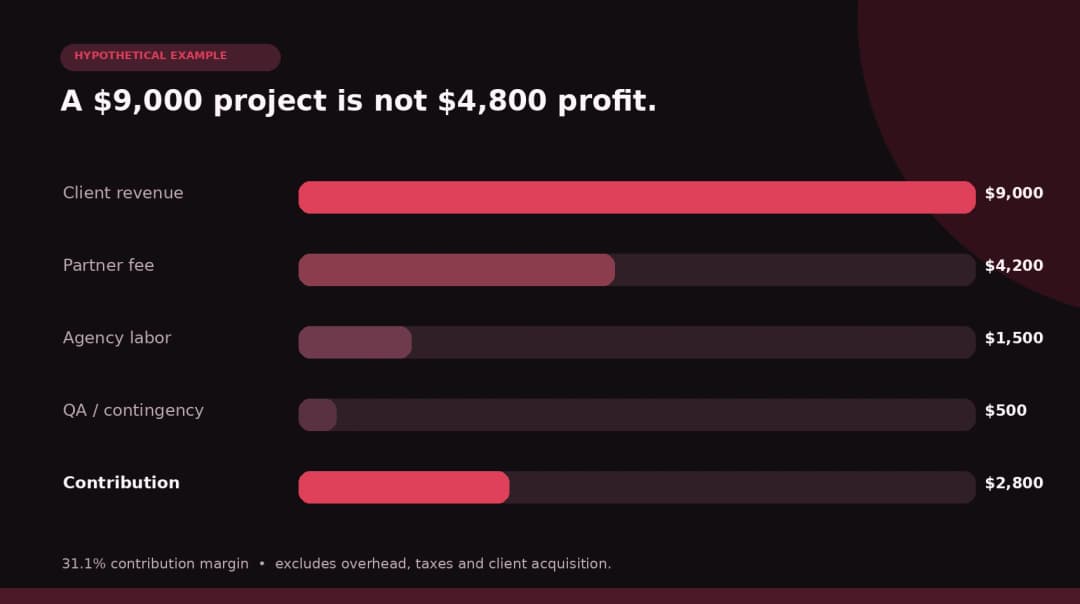
Suppose your agency quotes a client $9,000 for a defined WordPress redesign. You agree to pay a development partner $4,200. Your internal delivery work costs an estimated $1,500 for strategy, design review, project management, and client communication. You reserve $500 for extra QA and launch contingency.
The arithmetic is:
- Client revenue: $9,000
- Partner expense: $4,200
- Internal delivery cost: $1,500
- QA and contingency allocation: $500
- Illustrative project contribution: $2,800
- Illustrative contribution margin: 31.1% of revenue
That is not net profit: it excludes overhead, taxes, acquiring the client, and expenses outside these assumptions. A partner invoice of $4,200 might tempt an owner to say they have a 53.3% margin; once delivery costs and risk reserves are included, the picture changes dramatically.
For the same scope, compare two pricing views: markup on supplier cost and margin on total client revenue. Markup = (sale price − supplier cost) ÷ supplier cost. Margin = (revenue − all included project costs) ÷ revenue. State which number your team uses in proposals and forecasting.
| Cost line | USD | How to interpret |
|---|---|---|
| Client price | $9,000 | Revenue received for this project |
| Partner invoice | $4,200 | Third-party technical delivery |
| Agency labor | $1,500 | Delivery and project management assumption |
| QA / reserve | $500 | Contingency allocation |
| Contribution | $2,800 | Before general overhead, tax and CAC |
| Contribution margin | 31.1% | 2,800 / 9,000 |
Pricing models agencies commonly use
Fixed project price suits a stable, well-defined build with explicit change requests and acceptance criteria. Time and materials works for uncertain integrations or ongoing iterations but needs a burn report and ceiling alerts. Monthly retainer suits repeatable production needs when the contract clearly covers capacity, response windows, and rollover rules. Dedicated team or sprint capacity can help an agency with continuous delivery but requires stronger product management.
Avoid an unlimited-revisions promise unless your contract defines what counts as a revision, what counts as new scope, and which party absorbs the cost.
How to choose a white-label development partner
A partner website can look excellent and tell you very little about delivery reliability. A better evaluation begins with proof you can examine.
1. Ask for work close to your projects
If your clients need Gutenberg-native WordPress websites, ask for examples built using blocks and reusable patterns, not only screenshots of a visual page builder. For a custom application, ask about authentication, data boundaries, test strategy, deployment, monitoring, and repository ownership. If an example is confidential, the provider may offer sanitized evidence or a scoped technical demonstration instead.
2. Check the working agreement before the first invoice
Get written answers on client contact rules, portfolio rights, subcontracting, intellectual property, open-source licenses, confidentiality, data access, acceptance testing, warranty, change control, and early termination. Contract enforceability depends on local law; have qualified counsel review the actual terms. An NDA does not substitute for a complete delivery agreement.
3. Run a short technical pilot
Choose work that resembles your normal business. A responsive landing page with one form, approved analytics events, and a reusable component is a better pilot than a polished homepage screenshot. Evaluate code organization, accessibility, breakpoints, validation, communication, and how quickly the partner addresses review notes.
4. Test their communication habits
Notice how they handle uncertainty. Do they flag ambiguous requirements, document assumptions, and raise blockers before deadlines? A partner who says ‘yes’ to every scope request may be harder to work with than one who asks uncomfortable questions early.
5. Inspect the exit plan
Could another developer take over the project tomorrow? You should receive a usable repository or site export as applicable, environment setup notes, key dependencies, license ownership, deployment and rollback instructions, access inventory, and known limitations. Portability must be tested, not assumed.
What belongs in a white-label development agreement?
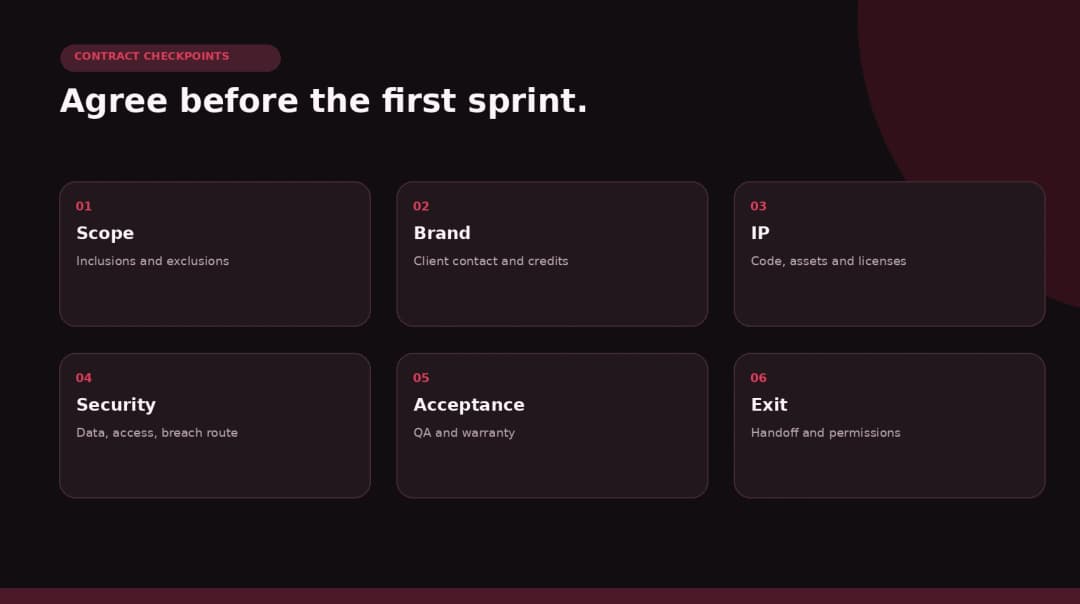
A useful agreement is specific enough that a new delivery manager can enforce it. Discuss the following categories before accepting client work:
- Services and scope: deliverables, exclusions, platforms, agreed browsers/devices, content migration, integrations, and who writes copy.
- Commercials: estimate validity, milestones, deposit terms, currency, billing for additional work, and cancellation costs.
- Client and brand: communication rules, use of agency email or accounts, portfolio/logo permissions, non-solicitation language where lawful, and the escalation path.
- Intellectual property: what is assigned, when assignment takes effect, licenses for third-party components, and rights to pre-existing code.
- Confidentiality and data: permitted access, retention, breach reporting route, subprocessors, storage location, and deletion/return procedures.
- Acceptance and warranty: how work is tested, who approves it, what constitutes a defect, the remedy period, and how urgent incidents are prioritized.
- Exit: access revocation, repository and license handoff, documentation, support transition, and what happens to incomplete work.
Legal terms need jurisdiction-specific review. Treat this as a procurement checklist, not legal advice or a template contract suitable for signing without counsel.
A practical workflow that protects the client relationship
The client should not become the project manager for two disconnected teams. Create a single brief, a single decision log, and a single source of truth for acceptance. One agency lead consolidates client feedback and sends it to the partner. The partner provides staging links and progress notes to the agency, which then manages client approvals.
A lightweight weekly cadence is usually enough for ordinary websites: a planned sprint scope, a midweek blocker review, and an end-of-week demo. Complex integrations may need more frequent technical check-ins. Record assumptions and decisions in writing; a chat history alone is a poor specification.
Use a definition of ready before coding: approved screen designs, content responsibility, integrations, environments, accepted scope, and access approved. Use a definition of done before launch: functional acceptance, responsive checks, accessibility review, performance checks, SEO safeguards, backups, deployment ownership, and handoff records.
Example: a fictional six-page agency website
A small creative agency sells a six-page marketing site to a professional-services client. It keeps UX, content, and account management internal and uses a white-label WordPress partner for implementation. The agreed build includes reusable Gutenberg sections, contact form routing, a blog index, editor documentation, and redirects from the old URLs.
During discovery, a request for a password-protected client document area appears. Rather than slipping it into the base six-page price, the partner identifies it as a separate feature with authentication, storage, and permission risks. The agency offers a scoped change request or a phase-two project. That conversation may feel slower, but it prevents an unfunded promise and protects the customer’s data.
This is an illustrative scenario, not an Omnix Studio case study or a published client result.
Technical QA: what the agency must verify before launch
Technical accountability does not disappear when development is outsourced. At a minimum, agree on what ‘done’ means for the site type.
Security and access. WordPress’s developer documentation recommends least-privilege roles and capability checks for sensitive actions. Its nonce documentation explicitly warns that nonces are not authorization checks. When API access is required, WordPress Application Passwords are individually revocable and are intended for programmatic connections, not sharing an administrator’s main password. Sources: WordPress roles, nonces, application passwords.
For custom applications, the OWASP Application Security Verification Standard 5.0 provides a structured set of web application security requirements. The exact scope should reflect the application risk, not a blanket claim that any checklist proves the site is secure. Source: OWASP ASVS.
Accessibility. W3C recommends using the latest WCAG version; WCAG 2.2 adds criteria beyond 2.1. A practical review includes keyboard operation, visible focus, form instructions/errors, contrast, and accessible names. Automated scanning is useful, but human testing remains necessary. Source: W3C.
Performance. Test real mobile experiences and Core Web Vitals rather than promising a 100-point score. Include Largest Contentful Paint (LCP), Interaction to Next Paint (INP), and Cumulative Layout Shift (CLS) in a measured baseline and improvement plan. Source: Google Search Central.
SEO and migrations. If URLs change, map old URLs to relevant new destinations, use appropriate permanent redirects, update internal links, and monitor Search Console after launch. Google’s site-move guidance warns that migrations can affect organic visibility, even with good execution. Source: Google site moves.
Reliability and handoff. Confirm backups can be restored, license keys are documented, forms reach the right inbox, analytics events fire correctly, staging URLs are blocked from search indexing where appropriate, and the client can edit approved content without breaking layouts.
| Gate | Evidence required | Accountable owner |
|---|---|---|
| Security | Permissions review; credential inventory | Named tech lead |
| Accessibility | Keyboard and form checks; issues logged | QA lead |
| Responsive and functional | Viewport tests and acceptance cases | Partner builds; agency accepts |
| Performance | LCP/INP/CLS context and measurements | Technical lead |
| SEO migration | Redirect map, canonicals, internal links | Agency SEO owner |
| Handoff | Repo, backup, licenses, access removal | Agency project lead |
The mistakes that quietly erase agency margin
The most expensive mistakes tend to be operational, not technological.
Selling a vague scope. ‘Modern redesign’ does not specify templates, breakpoints, data migration, search behavior, content entry, or integrations. Make the scope measurable.
Letting client feedback bypass the agency. A partner may receive contradictory directions or informal feature requests. Keep one approval channel, with exceptions agreed in advance.
Ignoring revisions in pricing. Three extra rounds of design changes, each requiring a build rebuild and retest, can consume the planned contribution margin. Define revision windows and change approval thresholds.
Giving broad admin access. Shared passwords and permanent administrator accounts increase risk. Issue individual access, choose appropriate roles, and revoke permissions during offboarding.
Treating staging approval as production QA. Staging and live environments differ. Check DNS, email sending, cache behavior, redirects, tracking, and actual payment or form workflows after deployment.
Overpromising secrecy. White label is a service arrangement, not a license to make false claims about team location, certifications, or expertise. Represent how delivery works accurately when contract terms or client expectations require it.
No warranty owner. If a form fails after launch, who investigates? How fast? Who pays for a regression vs. a new requirement? The answer belongs in your contracts and handoff pack.
White-label partner vs. in-house hire: which should an agency choose?
If your development demand is steady and strategically important, a dedicated in-house hire can build deep context and reduce repeated handoffs. If demand is variable or requires multiple specialties, a white-label partner may make capacity more flexible. A hybrid model often works well: keep a technical lead in-house and use specialist delivery partners for defined work packages.
Compare more than salary against supplier invoice. Include recruiting time, onboarding, benefits, utilization, supervision, downtime, software licenses, quality oversight, and the cost of replacing a departing employee. Then compare those to partner fees, project management, QA, and dependency risk. The correct answer depends on actual throughput and project mix.
| Factor | In-house hire | White-label partner | Hybrid |
|---|---|---|---|
| Best fit | Continuous core workload | Variable or specialist workload | Steady lead + flex capacity |
| Fixed commitments | Salary and management | Depends on contract | Both |
| Control | Direct daily oversight | SOW and review cadence | In-house technical gatekeeper |
| Main risk | Capacity gaps and hiring time | Handoff and dependency | More coordination |
| Exit risk | Employee turnover | Vendor transition | Requires documented processes |
How to start with white-label development in 30 days
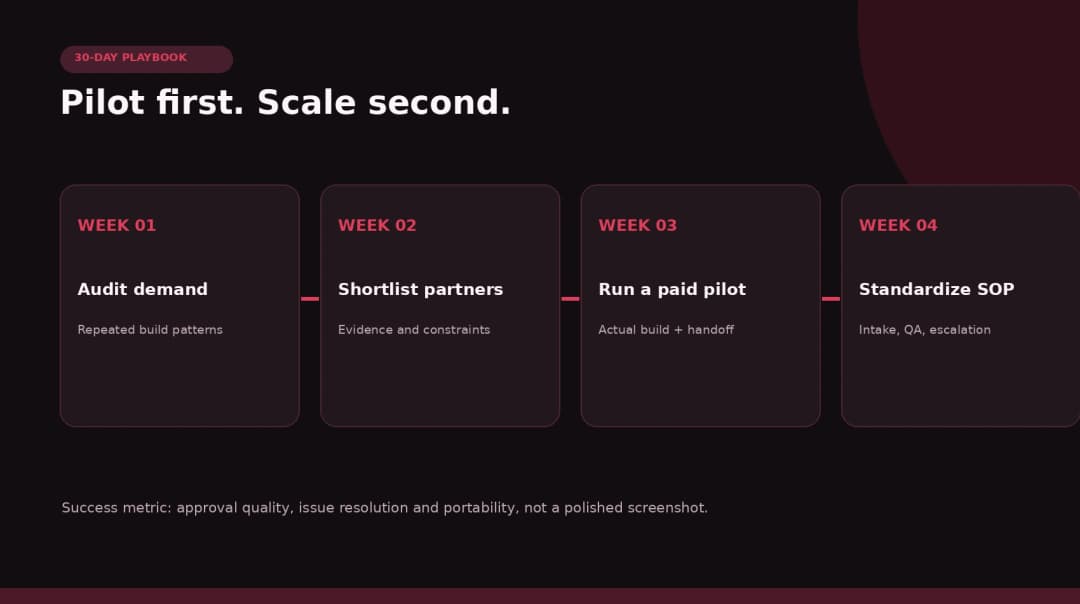
Week 1: audit demand. Review the last five to ten requests your agency accepted, declined, or delayed. Identify repeatable technology needs and list common failure points. Draft a one-page ideal partner profile.
Week 2: shortlist and validate. Review relevant work, technical approach, communication style, a sample estimate, confidentiality terms, and an exit plan. Ask one candidate to review a sanitized brief and identify unknowns.
Week 3: run a paid pilot. Use real acceptance criteria and a modest scope. Require a working staging preview, source or CMS access, written change log, and a short handoff note. Measure review cycles and response quality instead of treating a pretty screenshot as success.
Week 4: document the playbook. Turn lessons into an intake form, estimate template, handoff checklist, QA gates, escalation table, and standard review cadence. Decide whether to continue with per-project work or reserve recurring capacity.
Where Omnix Studio fits
Omnix Studio supports design and development partnerships for agencies that want additional production capacity without immediately building a larger permanent team. Its published agency partnership page describes white-label-friendly design and website-development support, while the services directory covers WordPress, custom web development, eCommerce, and maintenance.
A useful first conversation is not ‘how cheap can you build a website?’ It’s ‘which work should stay with our agency, which work could be delivered by a partner, and what would a safe handoff look like?’ Bring one representative brief, your current bottleneck, and your expected review process. That produces a more meaningful fit discussion than a vague request for unlimited capacity.
CTA: Need a dependable design-and-build partner for your next client project? Explore Omnix Studio agency partnerships.
Frequently asked questions
Is white-label web development legal?
White-label services can be lawful commercial arrangements, but legality and obligations depend on the contract, intellectual property rights, data-protection rules, consumer or procurement disclosures, and local law. Review the arrangement with qualified counsel where needed. Never assume an NDA settles every obligation.
Will my clients know I use a development partner?
That depends on the agreed model and your client obligations. Some partners remain invisible; others join client conversations or are disclosed as subcontractors. Define this before work begins, and avoid misleading statements.
Can I white-label WordPress development?
Yes. Agencies routinely use external specialists for themes, Gutenberg builds, migrations, integrations, WooCommerce, and maintenance. The agency still needs appropriate QA, security checks, and a clean owner handoff.
How much margin should an agency make on white-label development?
There is no universal target. Calculate contribution margin after partner cost, internal delivery work, QA, contingency, and any other project-level expenses. Then account for overhead, customer acquisition, and taxes before discussing net profit. Pricing should reflect the actual risk and value of the engagement.
Who owns the website and source code?
Ownership follows the applicable agreement and third-party licenses. Specify assignment terms, timing, pre-existing libraries, plugin licenses, repository control, design files, and exit procedures explicitly.
What if the partner misses a deadline?
Use milestone reviews, a blocker escalation route, and a contract that addresses material delays, remediation, acceptance, and termination. Tell the client what is known and what the recovery plan is; hiding problems typically makes them worse.
Should a white-label developer have direct client access?
Either model can work. Direct access can speed complex technical discussions, while agency-only communication protects a consistent relationship. Choose intentionally, clarify branding/disclosure, and use one documented approval process.
Is white-label development suitable for large web apps?
Sometimes, but it requires stronger architecture review, testing, security, data governance, and long-term support planning than a routine brochure site. Start with a proven partner and explicit risk controls before committing a critical application.
Final checklist before you sign
Confirm the scope and exclusions. Know the review cadence. Model your margin after real delivery costs. Establish who owns the repository, hosting, licenses, and credentials. Test the partner on a representative project. Require accessible, secure, documented work as appropriate for the product. And know exactly what happens if the relationship ends.
That is how white-label web development becomes a dependable way to expand your agency’s capabilities, rather than another dependency to manage.
Research and methodology note: This guide synthesizes official standards, market-context data, and common agency operating models as of October 14, 2026. The $9,000 margin example and six-page agency scenario are hypothetical. No agency-specific outcomes, rates, client quotes, security audits, or hands-on partner benchmarks are claimed.